Sunday, October 5, 2014

Exceptional Excerpts: The Power of One

Here are two scenes from the novel The Power of One by Bryce Courtenay.

The story is about a small English boy in South Africa-- Peekay-- who is just beginning an Afrikaaner boarding school during the second World War. He has been sent alone on a train with only his few belongings, leaving behind his beloved Nanny and his pet rooster, called Granpa Chook. The porter on the train, Hoppie Groenewald, is well known along all the stops as a welter-weight boxer. He introduces young PeeKay to the sport, as well as how to bet on it. This meeting changes Peekay's misfortunes as a victim of school bullies and leads to his fate as a tough fighter in a politically tumultuous part of the world. The prose is a pleasure to read as we follow the hard blows and victories of our small but resilient hero.

"The light which fled past the compartment window was still soft with a grayish tint; soon the sun would come and polish it till it shone. The landscape had changed in a subtle way. Yesterday's rolling grassland was now broken by an occasional koppie, rocky outcrops with clumps of dark green bush, each no more that a hundred feet high. Flat-topped fever trees were more frequent and in the far distance a sharp line of mountains brushed the horizon in a wet, watercolour purple. We were coming into the the true lowveld. 

I sat up and became aware of a note pinned to the front of my shirt. I undid the safety pin to find a piece of paper with a ten-shilling note attached to it. I was a bit stunned. I'd never handled a banknote and it was difficult to imagine it belonged to me. If one sucker cost a penny, I could buy one hundred suckers with this ten shillings. On the piece of paper was a carefully printed note from Hoppie.

Dear Peekay,

Here is the money you won. We sure showed that big gorilla who was the boss. Small can beat big. But remember, you have to have a plan-- like when I hit Jackhammer Smit the knock-out punch when he thought I was down for the count. Ha, ha. Remember always, first with the head and then with the heart. Without both, I'm telling you, plans are useless!

Remember, you are the next contender. Good luck, little boetie. 

Your friend in boxing and always,
Hoppie Groenewald

PS Say always to yourself, First with the head and then with the heart, that's how a man stays ahead from the start. H.G.

I was distressed at having left the best friend after Granpa Chook and Nanny that I had ever had, without so much as a goodbye. Hoppie had passed briefly through my life, like a train passing in the night, I had known him a little over twenty-four hours, yet he had managed to change my life. He had given me the power of one, one idea, one heart, one mind, one plan, one determination. Hoppie had sensed my need to grow, my need to be assured that the world around me had not been specially arranged to bring about my undoing. He gave me a defense system and with it he gave me hope."


˙˙˙˙˙˙˙˙˙˙˙˙

Second Scene:

"The fierce afternoon sun beat down, and below me the town baked in the heat. When was it all going to stop? Was life about losing the things we love the most as my granpa had said? Couldn't things just stay the same for a little while until I grew up and understood the way they worked? Why did you have to wear camouflage all the time? The only person I had ever known who didn't need any camouflage was Nanny. She laughed and cried and wondered and loved and never told a thing the way it wasn't. I would write her a letter and send her my ten shilling note, then she would know I loved her. Granpa would know how to do that.

As I sat on the rock high on my hill, and as the sun began to set over the bush veld, I grew up. Just like that. The loneliness birds stopped laying stone eggs, they rose from their stone nests and flapped away on their ugly wings and the eggs they left behind crumbled into dust. A fierce, howling wind came along and blew the dust away until I was empty inside.

I knew they would be back, but that for the moment, I was alone. That I had permission from myself to love whomsoever I wished. The cords which bound me to the past had been severed. The emptiness was a new kind of loneliness. Not the kind which laid stone eggs deep inside of you until you filled with heaviness and despair. I knew that when the bone-beaked birds returned I would be in control, master of loneliness and no longer its servant.

You may ask how a six-year-old could think like this. I can only answer that one did."

Thursday, October 2, 2014

The Slump, the Block, and the Import

Slump block.

That is the actual name of a building material. It is used extensively in the Southwest in place of bricks. It is a form of rough concrete that is compressed into slabs that are approximately two feet long and ten inches high. It is stronger than adobe, and not as smooth as cement. Its mold is made to look like rough hewn stone.

by Southwest Building Blocks

Even the name of it-- slump block-- always made me think of a big scoop of mud that had finally given up and lain down with a thud, flattened and elongated, with a sigh of "I give up."

1900 Life Magazine Illustration by Charles Dana Gibson
When I have a slump in creativity, or a block, or however we might describe the feeling that is the opposite of "oomph", it is usually because of pressure-- too much or not enough. Deadlines and crises are notorious for generating bursts of inspiration. Without them, our creativity can lie dormant and unformed until that feels like the way it should be. It takes a lot of convincing that what we could produce is important to the world. If it only seems important to ourselves, then we have to rely on a huge dose of ego to get going with it. 

One Man Band from polarity records.com

But for most people, ego alone isn't very convincing. In our hidden heart, we may fear that we have nothing to add of any importance. So the first thing we must look at is that word "important". That's the concept we do battle with every day. It's a descriptor for our actions, given to us by others. If a critic were to say of our work, "it's not perfect, but it's important," that would be like caviar and champagne flooding us with relief that our work, our time spent, their time spent, and our time on earth were all worthwhile. By contrast, a judgment of "well-crafted, but ultimately unimportant" threatens a sea of defeat with bitter saltwater.

The ego can fairly taste the champagne as it is working away, mere minutes from being the toast of the town. The heart fears with each sweaty beat that if one thing goes wrong, all will be sunken and lost. That tension can lead to slump block quicker than anything else I have experienced. It seems to me that if we get rid of "important" then we can eliminate the problem of having too much time with no deadlines, or not enough time to devote to our work because of too many competing deadlines. The word itself is helpful to look at so that we can dispense with it, at the levels of design and development.

Import: something that is brought in from somewhere else. Right there we see that importance is a value added to a work after its completion. If we try to add it into our work while we're making it, then that is like anxiously tasting and salting our cooking spoonful by spoonful as it bubbles, hoping to please. By the end, the salt is overpowering and it all has become inedible. It's better to allow the ingredients to show off their full flavor and then the guests can salt to taste at the table. Harsh criticism is like watching a guest shake all sorts of seasoning that they brought with them. Helpful criticism is like seeing which parts of the meal were left untouched. It doesn't feel negating, but challenging. We don't feel like slumping onto the couch laid out, but a little warmed up,  knowing that we can do better next time, and that will be fun.

Having fun in our work, or enjoying it, is vital. When something is truly fun, it isn't always pleasurable. But the fun is worth all of the unpleasant moments. If we're doing something only as long as it brings us pleasure, then it won't have much value for anyone else apart from the voyeuristic. That is when someone's production is deemed as navel gazing or worse, the dreaded "masturbatory". We see and hear examples all around us, of people tickling themselves by ranting against perceived competitors rather than providing critiques for evaluation. If they have not laid out a substantial argument, but simply wind up and then wind down and conclude-- because they have gratified themselves, or run out of steam, or time has run out-- then we know that someone has simply trotted out whatever they find pleasurable as an exhibitionist. Nothing was created or built upon. We're simply seeing an ego factory at work, that requires tricks and cheap thrills and shocks to keep it going. It is DOA, and not fun or enjoyable for anyone involved. 

Zobo Instrument Company advertisement

Creativity is enjoyable and brings us moments of satisfaction, but we keep working at our work because we are creative beings, not because we are important. Deciding ahead of time that the work we do isn't worthwhile, because it won't reach the higher echelons of importance, is too much pressure for anything to grow and offer up its flavor. Deciding that we might have work that could be important to people, maybe someday but not now, is not enough pressure. A creative block won't continue indefinitely unless we are colluding with the block and pouring energy into a really big one that can't be refuted. Even so, slump blocks are limited and even they can be made useful and into solid dwellings. Use it all, especially pent up frustration-- which equals heat and pressure-- and as you go, you'll see that it is good. 

Brut Champagne magazine ad 1915

Sunday, September 28, 2014

Part 2: "Son of Robert Downey Jr Says"

Iron Man from Tales of Suspense #45 Marvel Comics

The reason I reject all of these determinations is because they are fatalistic. The labels and the clichés can really get us boxed in when we most need to find as many ways of considering a situation as we can. At times, we need to step out of our self-images, favorite identities, and illness diagnoses as quickly as we change the costumes that go with them. It's one thing to know what your lot in life is-- what needs to be tended to and considered and respected. It's quite another to wear a label like a superhero or supervillian suit. What we do with our lives usually is found in the spaces between all of the things that we must supervise. Those spaces usually aren't focused on self at all, but is just a time we pass through, connected to other complex creatures and environs.

Photo of child unable to reconcile the reality with the role. Source: Dose.com
If any posed question about a person is answered with a label such as "He's an addict, she's a diabetic, they are Southern, he's Irish, she's a Pisces, he's a Mets fan, she's a woman, he's a man,"as if that explains it all, then we are heading into the realm of superstition, where we sense that we can understand and control people by the signs and myths that spring up around those labels. If you have ever found yourself in a statistical category, then you know how unsettling and soul-stripping that can feel. One feature of your life has just determined the rest, unfairly. And just as unfairly, a complete stranger can use their statistical category to gain unearned trust. An anonymous group that identifies themselves by an illness is still anonymous, and unknown. There is no way to skip over the work of discovering the reality about a person over time simply by trusting their mere presence in a room. Saints and sinners often show up at the same spots by the same routes.

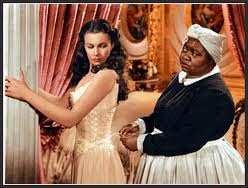
Determinism of any kind can prop up people who shouldn't be, but more often it holds us back as individuals and as societies. The feminist movement was an entire political transformation that transcended biological determinism. When women were called up for machinist duties during World War 2, did society unanimously believe in their capability based on past behavior? Or rather did society have a sudden widespread need? What would have been  considered impossible or at least unseemly in the antebellum south for women became commonplace and celebrated only fifty years later. Scarlett O'Hara's youthful "fiddle-dee-dee" was replaced by Rosie the Riveter's "We Can Do It!" They're both fictional characters who symbolize changing perceptions. As fictional characters, these female types were imagined by someone and produced as a stirring visual template for examples of both oppression or possibility, as needed.

Scarlett O'Hara getting her story straightened. From Gone With the Wind, MGM Studios
When we reduce a person's life to slogans and tag lines, it leaves little room for change and good old-fashioned surprise. How can someone fully recover if they are always in danger of losing the status of being a recovered someone? That seems like striving for perfect attendance, perhaps necessary but not sufficient for healing and growth. If everything is starting to seem scripted with snappy one-liners, then our thoughts and actions will get foreclosed before we even know that we are part of someone else's scenario. It is important to know how we came to believe what we can and should do, so that we are aware of how we will be told what we can't and shouldn't do.

Scarlett's successor and "Iron Woman", Rosie the Riveter, before being asked to go back home and re-don the petticoat of the 1950s
When I tell a story, I often am aware of my audience. I play up different aspects depending on what I think will compel them to keep listening and what will impress them to want to hear more of my stories. Or depending on my mood or what point I want to make as I am telling a story, I fill in, shade, highlight, accent, smudge, leave out, erase, crumple. There are no stories that are not spun. They start out as impressions and statements that are in a lump and then the person who decides to mold it, starts up the wheel. This isn't political, it's human. A spin is just a hip way of saying, "someone shaped a story for a purpose." Propaganda is usually easy to spot for most people. It's like hearing something reduced down until its easy to cheer or boo. We often know when we're participating in some sort of melodrama. It feels good at the time, but like a drug, it's not ultimately helpful or satisfying.

Sometimes we participate in propaganda-based stories we tell about ourselves. On some days we clap, and on others we hiss. Our story is simply one description of our life artifacts-- including details that we decided were valuable to our sense-making as we form the story. When faced with confusing facts, and more than one perspective, it is easy to cling to reasons and a feeling of knowing the Truth. We spend lots of time and energy on narratives, be they politically motivated, economically motivated, or personally motivated. We analyze how stories stress who deserves forgiveness, power, resources or attention. We argue about who is telling us which parts of the story and to whom. If all this sounds like a modern problem, it isn't; King Solomon said, "of the making of many books there is no end."

The same can be said of stories. You are a living, breathing person, and not a story arc. Stories are important, valuable, beautiful, frightening and instructive. But they aren't complete and they aren't Whole, as in the root word of "holy". Sacred sometimes, yes, but there is no whole Life canon. Canons are selected by a committee. We can exist apart from and outside of story, its structures and flights of fancy.  Our lives are not a myth, a fable, or a tale. Our selves aren't holy in the sense that they are untouchable, although we might wish that they were. Dave Chapelle, another highly paid actor said, "Once you're famous, you can never get unfamous. You can get infamous, but not unfamous."

While that seems right upon hearing it, Robert Downey Jr. has proven this to be false, as he was once the most infamous actor in Hollywood. It is fortunate for us that people are fickle at worst and forgiving at best. It is possible, and often advisable, to revisit our opinions of people and their motives.

A scant five years ago the only time you saw Robert Downey Jr. getting big play in your newspaper came when he was on a perp walk. Yet when it came time for Marvel Studios to cast the lead for a huge franchise film, Iron Man, it bet on Mr. Downey. He is not only back in the game but at the top of it. Is this a great country or what?"
-- NYTimes.com, Apr 20,  2008 "Been Up, Been Down. Now? Super." by David Carr

We can and should learn from stories and learn from others. But don't inherit your story passed down from the last time you told it. You inherited a lot to contend with: your place in history, in society, your family, or any displacement from those as well. Don't mix up your existence with what is said about you by anyone, especially not yourself, and whatever you do, don't trade in your life for a eulogy. Everything can change in a New York minute. And if you are the highest paid actor in the world, a success story, maybe question why that same story-seller has you being photographed as though you were either a lowly waiter or a rich tycoon on the doomed Titanic. It's impossible to tell which one Robert Downey Jr is playing here, and that's the point of his statement. You never can tell about a person from their story, and that's a good thing.

For complete article in Vanity Fair, October 2014, see here


Saturday, September 27, 2014

Robert Downey Jr says "I swear to God. I am not my story."

This is what Robert Downey Jr says in Vanity Fair's interview with him in their October issue. "I swear to God." However, the stylish cover insists: "How a Troubled Past Led to the Greatest Third Act in Hollywood History" (scroll to the end of part 2).  That sounds like a kind of redemption tale neatly fashioned by Hollywood itself, rather than a journalistic piece about someone who works in Hollywood. Did the writers of this subtitle (beneath the blaring "Highest Paid Actor in the World!") not hear what he was saying to them? Did he not say it as plainly as possible? Is he not practically pleading with them to refrain from crafting something similar to a movie pitch out of his life experiences? "I am not my story."

Vol. 1, Issue 128 by Marvel Comics

The problematic word here is "led". It might as well be used here as an equal sign. One thing does not always lead to another specific and easily understood thing. Our highest aims and lowest misses rarely tally up to what we have planned. I doubt that he, himself, could explain all the twists and turns of his career. And why would anyone try? It is vanity, indeed, in the sense of futile. (See previous post on the Knights of the Holy Grail.)

In this article, he is speaking in the context of his and his son's struggle with addiction. But the emphatic statement hits upon a broader truth that we are not our stories. You might think that I would disagree, being a writer, but I applaud him for saying this. We aren't our reputations. We aren't what we are generally known for and that's all. We have private selves that don't trot along nicely for everyone to comprehend. If anything led Downey, I doubt that it was his past. Rather, I think he, as a complex person, broke through his reputation as untrustworthy-- and therefore not bankable-- in ways that are unclear and don't follow a careful trajectory.

We humans can get addicted to storytelling. Most of us like stories to be unfolding all around us. We can get lost in them, and someone else's story can become a wonderful way to escape the burden of daily existence. Whenever a situation starts to feel difficult or painful or bewildering, finding some meaning in it can help with perseverance in coping or accepting the whole thing. Going through a bad time without purpose is one of the worst existential states. It hollows us out, spiritually. A sense of purpose can be the Holy Grail that we might waste a lot of time chasing. Sometimes we can only see purpose in hindsight, but we don't always have a sensation of fulfillment while we're going through it. Not everything exists for a specific purpose or meaning. To paraphrase Joseph Campbell, "What's the meaning of a flower? When the grass is cut, does it stop growing and say, 'Oh what's the use?'"

The heroic story of Man against Nature, Saturday Evening Post, August 6 1910

I imagine that going through a drug withdrawal and rehab situation might feel draining and purposeless on top of its physical and social miseries. There's no "reason" for it, and it affects everyone surrounding the person who suffers from addiction, like any bodily illness. Chemical substances are a conspicuous source for addiction, but Story is just as much as substance as any other in its ability to work on our brain's reward center.

There are times when writing fiction can feel like a drug. I sometimes muse about my characters, what I am going to make them do, what I am going to force them to go through, and how I'm going to save them or not. It feels powerful and satisfying and soothing all at once. Like a hit of godhood. I can be as capricious or benevolent as I want, and nobody gets hurt. At least I like to think so. When I am working on writing an alternate reality, I'm not in the actual one around me; the reality in which things happen even if I'm not paying attention. This disconnected state could seem fairly lifeless to anyone in the room with me, especially if I began to collect dust. So far, no one has complained, and generally, people have been positive. Writing fiction is considered a healthy outlet in the times that I live in, and that is lucky for me.

Our society did not always feel this way about stories. Storytelling is something that has gotten to us by bootleg and like many pleasantries is now not only acceptable, but encouraged and celebrated. The novel used to be considered a waste of paper and a trashy, unproductive past-time. We think about oral traditions with reverence now, but that's usually because they have some sort of archaeological or historical value determined by all sorts of scholars.

As individuals, we all judge what stories we feel to be relevant or engaging all day long, because they come at us all day long. They are our news programs, movies, books, medical journals, almanac entries, judicial reviews, quarterly reports, property assessments, blogs, your partner's day, pro tips, explanations, excuses and lies. Some stories sell better than others.


Precursor to "The Big Book" of Alcoholics Anonymous
I admire the many people who have created a space for people with addiction problems. But I am never a fan of substituting one addiction with another. I don't know enough about addiction to weigh in about the effectiveness of treatments. But I sometimes get an uncomfortable feeling that the Story We Tell About Ourselves can become the substitution. (Or hearing Stories Other People Tell About Themselves, especially on social media.) However, Story is something I am familiar with, and so I can weigh in on that much, at least.

If there is anything we post-moderns have learned, it's that Story is perplexing and changeable and subject to multitudes of interpretations. When Robert Downey, Jr says that he has inherited his addiction, and so has his son, he is speaking to a reality that exists on a cellular level that can't be ignored. That reality requires treatment, which will probably be made up of many different approaches. But addiction is only one part of his life, as is his bodily inheritance.

"What are we going to do about inherited imperfection? The answer is that we don’t change the way we are, we change the way we live."-- Steve Jones, Professor of Genetics, Evolution and Environment, University College London

Don Quixote Reading (his own "Big Books", Chivalric Tales) by Adolph Schroedter
Downey goes further than saying he is not his imperfect inheritance. He asserts that he, himself, is not a perfect story with addiction as a prominent feature. If he is a person who is not determined by his cellular reality, then neither is he determined by a "celebrity rehab" story. While I appreciate the wisdom of respecting the nature of a powerful beast-- in this case, addiction-- I can't help but anticipate the follow-up story that so often arises from the human desire to see people fall after a grand triumph. Because of that, I reject not only a biological determinism, but a narrative determinism as well. His future is not necessarily a product of his past.

"The Drunkard's Progress" an illustrative and scripted narrative lithograph produced by Nathan Currier in support of the Temperance Movement, 1846

In life, we are not following structures of a plot complete with themes, tropes, motifs and stage cues. If we were, then we would all be tilting at our own windmills, fearing that they might be giants. Sometimes a story holds too much power over us, and needs to be not only unraveled, but also un-reveled. Celebration is good, but it's never an ending point. There is far more to us than could ever be dreamed up by any philosophy, either romantic or fatalistic. People exist outside of a marketplace mentality of stats and futures that reflect the trending and consumption of the individual, which is what these interview stories are. It's important that we don't become consumed by our stories, neither by the ones we tell or the ones that are told about us.

A different kind of Iron Man altogether, Don Quixote and the Windmills, 
Illustrated by Walter Crane

Sunday, September 21, 2014

Grinnin' in Your Face

The famous guitarist and songwriter, Jack White, cites this as his favorite song. So, I looked it up, and felt so lucky to have been made aware of this blues master called Son House. I think I now have to rank it among my favorite lyrical poems, as well as a song.

As he sings, I can see faces that smile to him as they lie. I hear the voices that talk about him and make up their minds about him, apart from him. I feel the hurt of each discovery that people have tried to dominate him in a queasily teasing manner, to skirt trouble with him, perhaps to get something from him dishonestly or cheaply, to smooth over a wrinkle, or to deflect a pointed question.

It makes B.B King's "The Thrill is Gone" feel almost overdone and melodious by comparison. I have never heard a plaint of anger and hurt quite this raw, but controlled all the while with an acceptance of how people are to each other, and proffered wisdom: pay scant attention and don't change your course.


This song, sung a capella without his guitar, accompanied only by clapping, might not be considered the finest piece of musicianship. But it really is one of the best lines of poetry I have ever heard, and sung with an incredible of blend of pathos and restraint. It feels to me like the root of blues, not in terms of chronology, but in tone. It also carries a stillness with it, a calming "hush now," instead of an incitement to bitterness.

All of this is like a rich consommé of emotion distilled into eight words. Thank you, Jack White, you trickster. We'll come back around to talking about you here, soon.
Picking and grinning himself, Jack White recently performed "Mother Nature's Son" at the White House honoring Sir Paul McCartney, singing in a Beatleseque voice, playing on his old, hard-to-keep-in tune guitar, and all this following comedian Jerry Seinfeld. Only you would set for yourself that challenge. Only you.


Tuesday, September 16, 2014

Mark Twain's Famous Rant: The Literary Offenses of James Fenimore Cooper

Mark Twain really hated the writing of James Fenimore Cooper, who was famous for the creation of his character, Natty Bumppo of the Leatherstocking Series. The actor Daniel Day Lewis played Nathaniel "Hawkeye" Bumppo in the film "Last of the Mohicans" where he saves the day for a prettily distressed damsel captured by some rough-looking, sociopathic Indians. As Twain says of a Cooper Indian, "there was seldom a sane one among them."

Cooper Indians also lurk obviously between portrait-framing trees while Natty & Friend nonchalantly chill beside their sinking canoe
We first meet Monsieur Le Bumppo as a remarkably capable woodsman in The Pathfinder and next The Deerslayer. As a kid, my sister had these books on her shelf, and I would really hate to ruin harmless stories for anyone. Also, I'm not sure that Twain carried a personal dislike of Cooper, as a person. Maybe he was just galled by Cooper's fame and even critical acclaim, as some begrudge the popularity of Charles Dickens, J.K. Rowling or Stephanie Meyer.

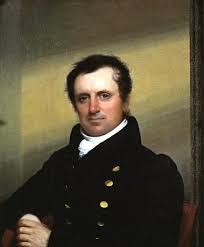
Portrait of J.F. Cooper in a naval uniform by John Wesley Jarvis
I have wanted to read this book of "offenses" even before I knew it existed, from the moment the first clunk of dialog hit my ear by way of the movie trailer. It shows a scene of Daniel Day Lewis in fringed leather revealing tanned chest muscles, crooning through long windblown and rain-soaked locks, "Stay alive, no matter what occurs. I will find you." I winced at "occurs." Why say a crusty "occurs" which belongs in phrases about natural elements, accident reports, or sudden thoughts; instead of the commonplace and fateful "happens"? And why say such a word to a beloved as she is about to be stolen away at night in a storm? Of course, the important part of Natty Bumppo's-- er, Hawkeye's communication is not that he will keep searching until she is found, simply because he loves her. Rather, he will inevitably find her because he is Natty Bumppo and nothing can stay hidden from him. This must have been a relief to the young male readership of a "Romantic" novel because, you know, mushy stuff. But Daniel Day Lewis saves the film's day by elevating the unrealistic dialog and action scenes by sheer physicality and strength of his own will as an actor. I imagine that even Mark Twain would commend his ability to accomplish that.

The American tale heard 'round the world
Critics who were also fans of Fenimore Cooper's books found each of them to be a "pure work of art" proclaiming Señor El Bumppo to be "one of the very greatest characters in fiction", which he could hardly fail to be if he did indeed possess "the craft of the woodsman, the tricks of the trapper, all the delicate art of the forest… familiar to Cooper from his youth up" as a Professor Brander Matthews described him. If this weren't enough for Twain to swallow, he had to hear a fellow prominent writer proclaim that Fenimore Cooper was "the greatest artist in the domain of romantic fiction yet produced by America."

N.C. Wyeth illustrated a blonde Bumppo displaying the "delicate art of the forest".
As a contemporary of them all, Mark Twain was having none of it. When I first came across the title,  The Literary Offenses of James Fenimore Cooper, I promised myself that I would read it someday. Who else could get away with such carefully outlined snark, and so publicly? On a short flight recently, I thought that it would be the perfect time to finally open it up because of its short length. I soon had the feeling of trying not to laugh in church. Twain's humor often creeps up like a crafty serpent, until I'm not exactly sure why I'm laughing, but I'm sure that something uncharitable and naughty, yet inarguably true has been said. The man just got away with stuff. I really did try not to let my shoulders shake as I silently read. I could imagine how potentially offensive it could be to sit beside someone flying solo, laughing over a private joke.

Stronger than your average bear
So, here are my favorite Offenses of poor James Fenimore Cooper (who really should have thought through how a one hundred and forty foot barge can round a thirty foot bend in the stream, if he was going to take the trouble to give us the measurements):

"There are nineteen rules governing literary art in the domain of romantic fiction-- some say twenty-two. In Deerslayer, Cooper violated eighteen of them. These eighteen require:

2. They require that the episodes of a tale shall be necessary parts of the tale, and shall help to develop it. 

3. They require that the personages in a tale shall be alive, except in the case of corpses, and that always the reader shall be able to tell the corpses from the others. But this detail has often been overlooked in the Deerslayer tale.

4. They require the the personages in a tale, both dead and alive, shall exhibit a sufficient excuse for being there. But this detail has also been overlooked in the Deerslayer tale.

5. They require that when the personages of a tale deal in conversation, the talk should sound like human talk, and be talk such as human beings would be likely to talk in the given circumstances, and have a discoverable meaning, also a discoverable purpose, and a show of relevancy, and remain in the neighborhood of the subject in hand, and be interesting to the reader, and help out the tale, and stop when the people cannot think of anything more to say. But this requirement has been ignored from the beginning of the Deerslayer tale to the end of it.

7. They require that when a personage talks like an illustrated gilt-edged, tree-calf, hand-tooled seven dollar Friendship's Offering in the beginning of a paragraph, he shall not talk like a negro minstrel in the end of it. But this rule is flung down and danced upon in the Deerslayer tale.

8. They require that crass stupidities shall not be played upon the reader as "the craft of the woodsman, the delicate art of the forest," by either the author or the people in the tale. But this rule is persistently violated in the Deerslayer tale."

"In addition to these large rules there are some little ones. These rules require that the author shall:

12. Say what he is proposing to say, not merely come near it.

13. Use the right word, not its second cousin.

14. Eschew surplusage."
Young Mark Twain, sharing a resemblance with Woody Harrelson, who likes to play him
I'll leave you with my favorite example of an offense. By uttering the following lilting phrases regarding his   absent damsel: "She's in the forest-- hanging from the boughs of the trees, in a soft rain-- in the dew on the open grass-- the clouds that float about in the blue heavens-- the birds that sing in the woods-- the sweet springs where I slake my thirst-- and in all the other glorious gifts that come from God's providence!", Natty Bumppo reveals that he must have wandered over from another famous romantic tale, Cyrano de Bergerac, where he can play both roles of poetic Cyrano and the inarticulate friend as he pleases, by also uttering, "It consarns me as all things that touches a fr'ind consarns a fr'ind."

Interesting, and I… um… what?

Thursday, September 11, 2014